CQ WPX SSB Contest 2026: Working All Continents and VK6 on the Long Path
After participating in several amateur radio contests in telegraphy last year, I wanted to also take part in a phone contest. The amateur radio operators call that SSB which stands for single sideband. It is the most common analogue voice transmission mode. I still consider myself to be a contest rookie - this was only my sixth contest and the first time operating SSB during a major contest.
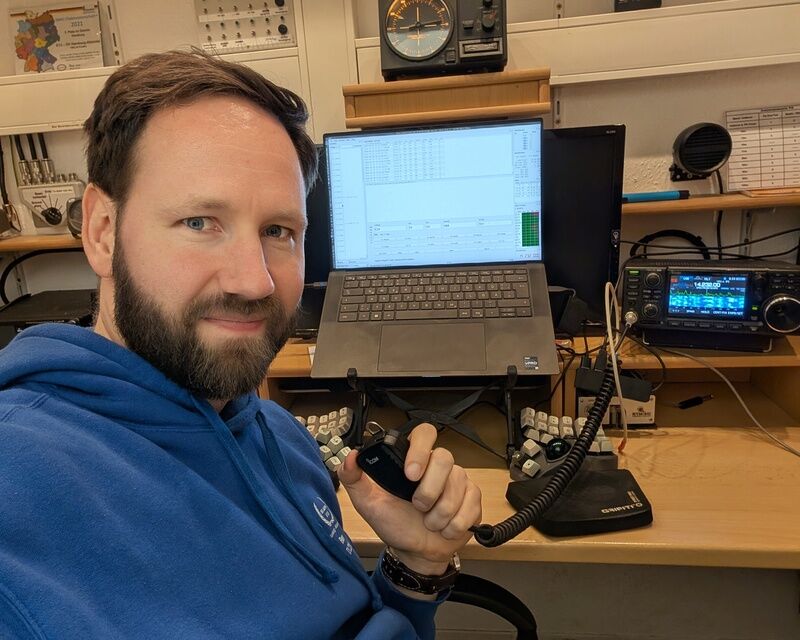
For this contest I was able to use the big station of my local amateur radio club. That enabled me to work in the High Power category and use the three element yagi for the 20, 15 and 10 meter bands. For me it is an exciting station as I cannot really raise antennas at home.
My Goals for the Contest
Before the contest I sat down and thought about my goals for the contest. I wanted to only work a couple of hours but make the best out of it. For the Two Modes Award from the DIG I was lacking SSB contacts with south america and oceania that are confirmed by QSL Cards1 or via Logbook of the World2. So I set it as my goal to get at least one confirmation from both of these continents. Confirmations from stations in countries I have not yet worked, so called DXCCs3, would also be nice but were not a primary goal. As for my placement in the contest the goal is to not be the last station in my category.
Making a Plan for the Weekend
Having these goals in mind I planned my contest weekend. I’d start on Saturday after noon, take the bus to the club station and setup my Linux logging PC. During the afternoon I would try to work south America. In the evening I would try working stations on the low bands, knowing that the low band antennas are not the strength of the station. Then I’d call it a day go home and get some sleep.
On Sunday I would get up early to start operation around 6:00 UTC and try to catch Oceania and some asia. Around noon I’d call it a day and have the rest of the day to recover.
Report from Saturday
I arrived as planned and had the station ready to log the first QSO4 at 12:23 UTC5. After checking the first QSOs on 40m I jumped onto the 15m band turned the beam to south America and directly worked P45A in Aruba.
At 12:57 UTC, I switched to 10m, turned the beam to 240°, and immediately heard PY2KQ calling. That was the moment - South America was wide open. Over the following 36 minutes, the band delivered: PY2KQ, PY2MP, PY2WB, and PY2UD from Brazil, then LU2FE from Argentina. I was surprised by how good the propagation on 10m was. With a solar flux index of over 160 after it had been below 150 for weeks the conditions were awesome. On 10m there was barely any QRM noticeable. Times like these are really the fun of being an amateur radio operator.
After I had worked the bands front to back and had my goal for south America already achieved, I took a look to the cluster. I tried to spot some stations from new to me DXCCs. Cape Verde was exceptionally active with three different D4 stations worked. Indonesia (YB) gave me a backup for Oceania, just in case I would not be able to work Australia on Sunday.
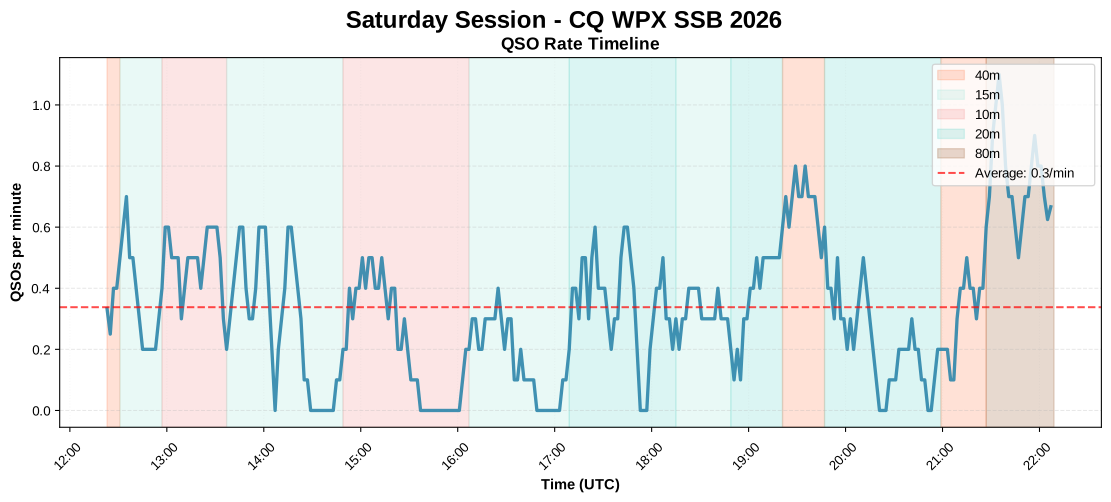
As the afternoon wore on, the 20m band gave me multiple north American stations but also Europe and even China and Indonesia. As I was sure at least one of the Indonesian stations would confirm the contact with QSL I had my goals already achieved on Saturday evening!
As darkness fell, I moved down to 40m and then 80m. This turned out to be the fastest part of the contest - 80m was absolutely packed with European stations, and I logged 33 contacts in 40 minutes. There was much QRM6 on 40 and 80 though which made it really tough to hear the stations.
With all my goals achieved and a bunch of new DXCCs in the log, I packed up and headed home at 22:09 UTC for a short night’s sleep. The clock would jump forward an hour as we slid into summer time and that would cost me another hour of sleep.
Early Start on Sunday
On Sunday I jumped on the early bus and logged my first QSO at 05:48 UTC. That day started much slower as there were only a few stations calling in the morning. I checked 15m but went back to 20 as there was not much going on at that early time. After some time I was able to work south Korea, Kyrgyzstan, Kazakhstan, and Japan.
The Highlight of the Contest
Still no Australia so I had the idea to try 20m on the long path. My beam was pointed west at 290° and heard VK6NC loud and clear. I called, and they came back!
This was my moment of the weekend. I finally had Australia in the log. It was my 234th QSO of the contest, and probably the most satisfying. Taking advantage of them being in the grayline during their sun set, the contact was made on the long path - roughly 26,000 kilometers going west through the Atlantic and Americas, rather than the shorter 14,000 km path through Asia.
After this contact I had to take a short break. There are not many moments like this.
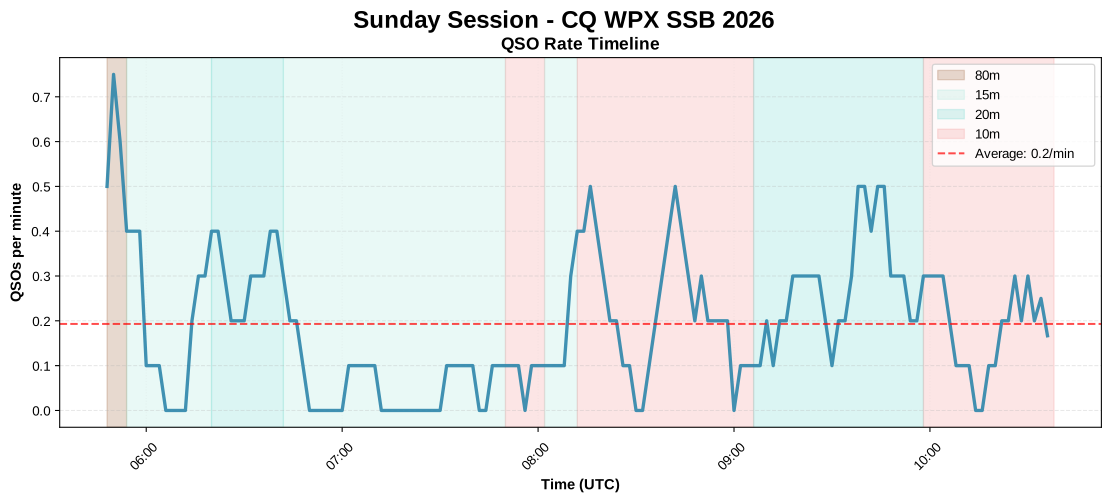
For the final stretch, I returned to 10m to sweep up any remaining remote stations. The last 40 minutes yielded some fantastic catches: Namibia, Bangladesh, and HC8NA from the Galapagos Islands!
After that I was extremely exhausted and called it a day at 10:37 UTC.
Conclusion
Next time I would probably not start this early on Sunday as the first hours were a bit of a slow start. I could have instead used some more night time on the low bands.
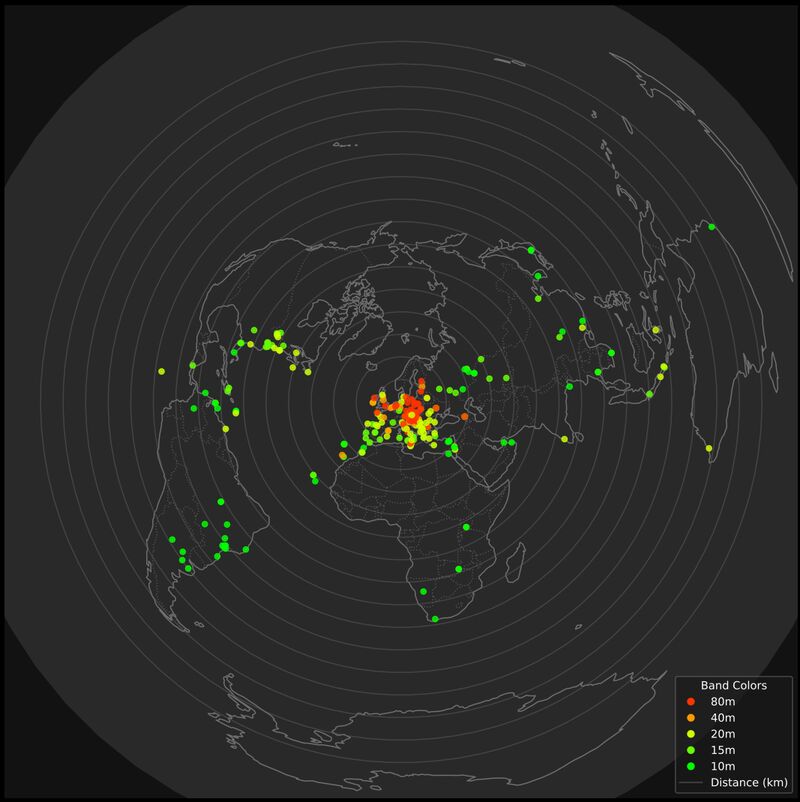
I would not have thought that this contest would be that successful that made me really happy. Not only did I work the desired contacts with south America and Oceania, but I also managed to work 27 new DXCCs in SSB and 13 new ones regarding all modes. As we are on the decline of Solar Cycle #25 it was awesome to get to work a contest with stellar conditions once more. The 20 hours of operation time during the contest were more than expected. They yielded 256 QSOs in total. And I can tell that by now I have gotten the missing QSLs so I’ll get my “Two Modes Award”! In the end I’m really thankful for the experience of working an SSB contest at a very capable station.
Footnotes
QSL Cards are written confirmations of radio contacts, traditionally exchanged between amateur radio operators as proof of communication.↩︎
Logbook of the World is an electronic QSL card system maintained by the American Radio Relay League for confirming contacts over the internet.↩︎
DXCC stands for DX Century Club, an amateur radio award program where operators collect confirmations from different countries and territories. Each country that got assigned an DXCC country code is just called “a DXCC” in amateur radio jargon.↩︎
QSO stands for a two-way radio contact between amateur radio stations. The term comes from the Q code system used in radio communication.↩︎
UTC stands for Coordinated Universal Time, the time standard used worldwide for radio communications to avoid timezone confusion.↩︎
QRM refers to man-made radio interference from other stations or electrical devices.↩︎